Why Choose XMPP
Freedom to Communicate Without Being Tied to a Single Company
Most popular messengers are centralized platforms. Their developers have complete control over the servers, applications, registration rules, and users’ access to the network.
XMPP works differently. It is an open and federated protocol: you can choose your own server and application or even run your own server. Users of different XMPP servers can communicate with one another, much like people using email addresses from different providers.
Your account belongs to the server you choose—not to a closed platform.
Key Advantages of XMPP
- An open standard. XMPP is defined by publicly available specifications, including RFC 6120, published by the IETF.
- Federation. Users do not need to register on the same server to communicate—independent XMPP servers can interact with one another.
- Choice of application. You are free to choose your preferred XMPP client for your computer or mobile device.
- Self-hosting. Organizations, communities, and individuals can run their own servers and control their infrastructure and data-retention policies.
- Registration without a phone number. Creating an XMPP account usually requires only a username and password.
- End-to-end encryption. Compatible clients support OMEMO, OTR, and OpenPGP. For everyday communication, we recommend the modern OMEMO encryption protocol.
- Multi-device support. A single account can be used simultaneously on a computer, smartphone, and other devices.
- Flexible connectivity. Depending on the client and server configuration, XMPP can be used through a proxy, VPN, or Tor.
- Control over your data. Message-retention and technical logging policies are determined by the operator of the server you choose—not by a single global corporation.
- Extensibility. Open XEP extensions add support for group chats, file transfers, calls, reactions, message-history synchronization, and many other features.
Comparison with Popular Messengers
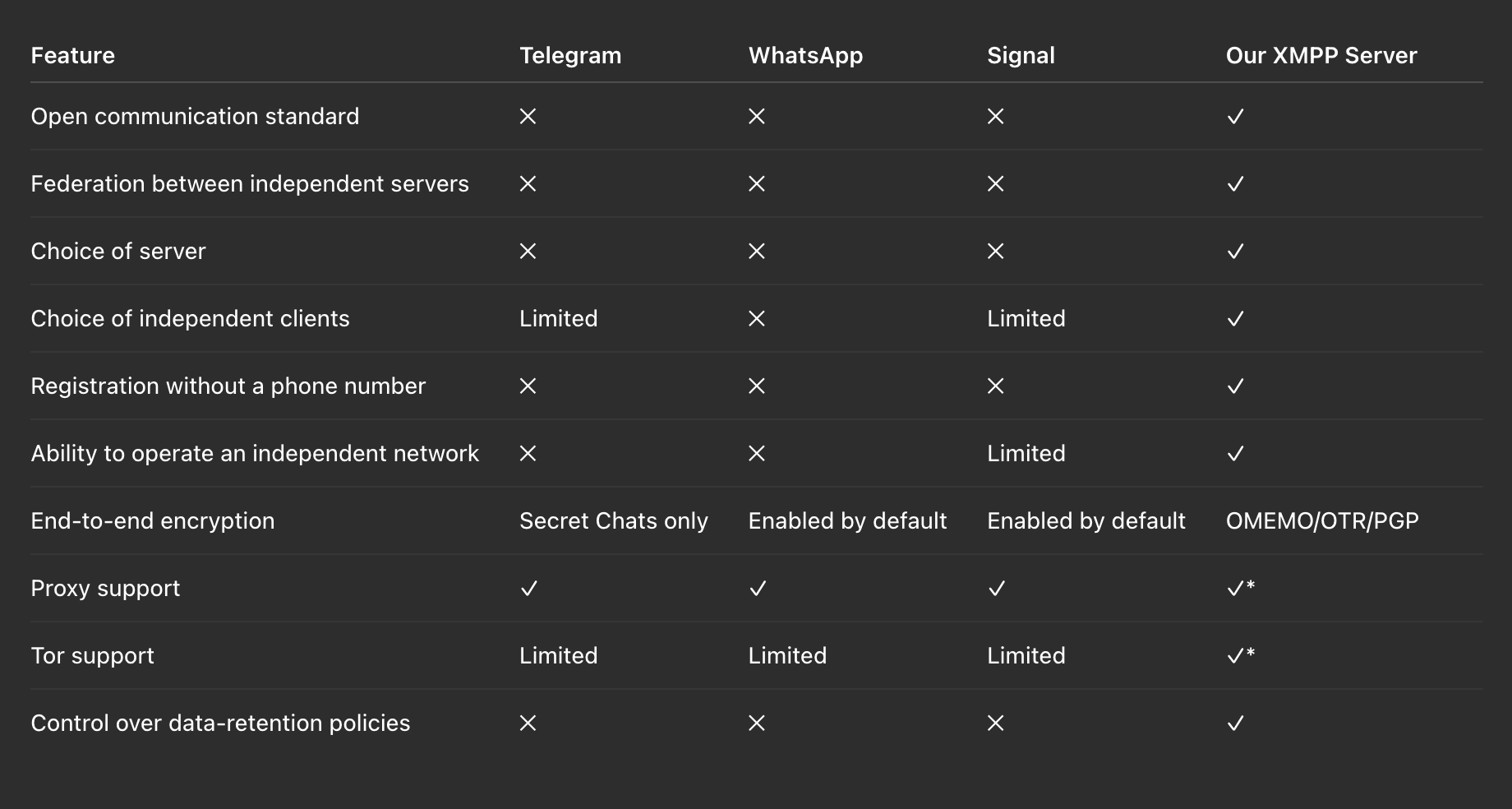
- Proxy and Tor availability depends on the XMPP client and server configuration.
An Important Note About Encryption
XMPP itself provides an encrypted connection to the server, but end-to-end encryption depends on the client you use and the encryption method you select.
For confidential conversations, we recommend enabling OMEMO. When OMEMO is enabled, messages are encrypted on the sender’s device and can be decrypted only by the devices belonging to the conversation participants. The server administrators do not have access to the keys required to read these messages.
Privacy on Our Server
We do not read or analyze the contents of private messages. The server does not keep logs of message contents or use user data to create advertising profiles.
To ensure stable operation and protect against abuse, the server may temporarily process a minimal amount of technical data that does not include message contents.
Freedom of Choice Instead of Platform Dependence
Telegram, WhatsApp, and Signal can be convenient and secure communication tools, but each remains a separate centralized network. Users must accept the rules established by the platform owner and rely on the infrastructure it provides.
XMPP takes a different approach: an open protocol, independent servers, freedom to choose your applications, and the ability to control how your communications are managed.
It is more than just another messenger. It is an open communication network that does not belong to any single company.
Sources
Telegram FAQ — end-to-end encryption is used in Secret Chats, while regular conversations are cloud chats.
Telegram Privacy Policy — information about the storage of cloud chats and Secret Chats.
WhatsApp Security — end-to-end encryption for personal messages and calls.
Signal Privacy Policy — information about the processing of user data.
Signal Proxy Support — official support for connecting through a proxy.
XEP-0384: OMEMO Encryption — OMEMO end-to-end encryption for XMPP.
RFC 6120 — the core XMPP protocol specification.
XMPP Providers — a directory of public XMPP servers.
XMPPBL — a list of XMPP domains associated with spam.